Maryland 36-Hour Driver Education Course: What’s Included?
What Is Included in the Maryland 36-Hour Driver Education Course?
If you are preparing to get your first driver’s license in Maryland, you have probably heard about the 36-hour driver education course. But what actually happens during those 36 hours?
The short answer is that Maryland’s certified Driver Education Program includes a minimum of 30 hours of classroom instruction and 6 hours of behind-the-wheel training. The more useful answer is that these two parts are designed to work together: one develops the knowledge needed to understand Maryland roads, traffic laws, hazards, and safe-driving decisions, while the other gives you an opportunity to apply those principles behind the wheel with an instructor.
Understanding that distinction is important because completing driver education is only one part of Maryland’s licensing process. New drivers may also need a learner’s permit, supervised practice hours, a practice log, and eventually the driving skills test, depending on their circumstances.
For students looking for a Maryland 36-hour driver education course, knowing what is included before enrolling makes it easier to choose the right school, understand what you are paying for, and prepare for each stage of the process.
Why Is It Called the 36-Hour Driver Education Course in Maryland?
The name comes directly from the minimum amount of formal driver education required: 30 hours of classroom instruction plus 6 hours of behind-the-wheel instruction.
These are not 36 identical hours of training. Each part serves a different purpose.
Classroom instruction builds the foundation. Students learn how traffic laws, signs, road conditions, driver behavior, risk management, and safe-driving principles affect the decisions they will eventually make on the road.
Behind-the-wheel instruction turns that knowledge into practical experience. Instead of simply discussing what a driver should do, the student practices driving with an instructor and receives feedback based on actual performance.
Maryland regulations require the classroom portion of the approved curriculum to be taught in its entirety and according to standards established by the Motor Vehicle Administration. The state also requires at least six hours of behind-the-wheel instruction.
This combination is what makes the Maryland Driver Education Program more than a basic driving lesson or a test-preparation session.

What Is Included in the 30 Hours of Classroom Instruction?
The classroom portion is where students build the knowledge needed to understand the driving environment before making decisions independently on Maryland roads.
Although students often think of driver’s education as learning how to physically operate a vehicle, safe driving involves much more than steering, braking, and parking. Drivers constantly interpret signs, anticipate the actions of other road users, evaluate hazards, manage speed, and decide how to respond when conditions change.
The classroom curriculum provides the framework for making those decisions.
Students can expect driver education to address core subjects connected with traffic laws and regulations, road signs and pavement markings, responsible driving behavior, roadway risks, safe driving practices, and the knowledge required to operate a vehicle responsibly.
That knowledge becomes especially important once a new driver begins practicing in real traffic. Knowing what a sign means is one skill; recognizing it early enough to react safely while controlling a moving vehicle is another.
Maryland also updates its driver education curriculum as laws and safety requirements change. For example, MVA announced curriculum changes related to Maryland work-zone signage following changes that took effect in 2024. This is one reason students benefit from receiving instruction through an approved program rather than relying exclusively on old study materials or informal advice.
The objective is not simply to memorize enough information to pass an exam. Effective driver education in Maryland should help students understand why safe-driving rules exist and how those rules translate into everyday decisions behind the wheel.
What Happens During the 6 Hours of Behind-the-Wheel Training?
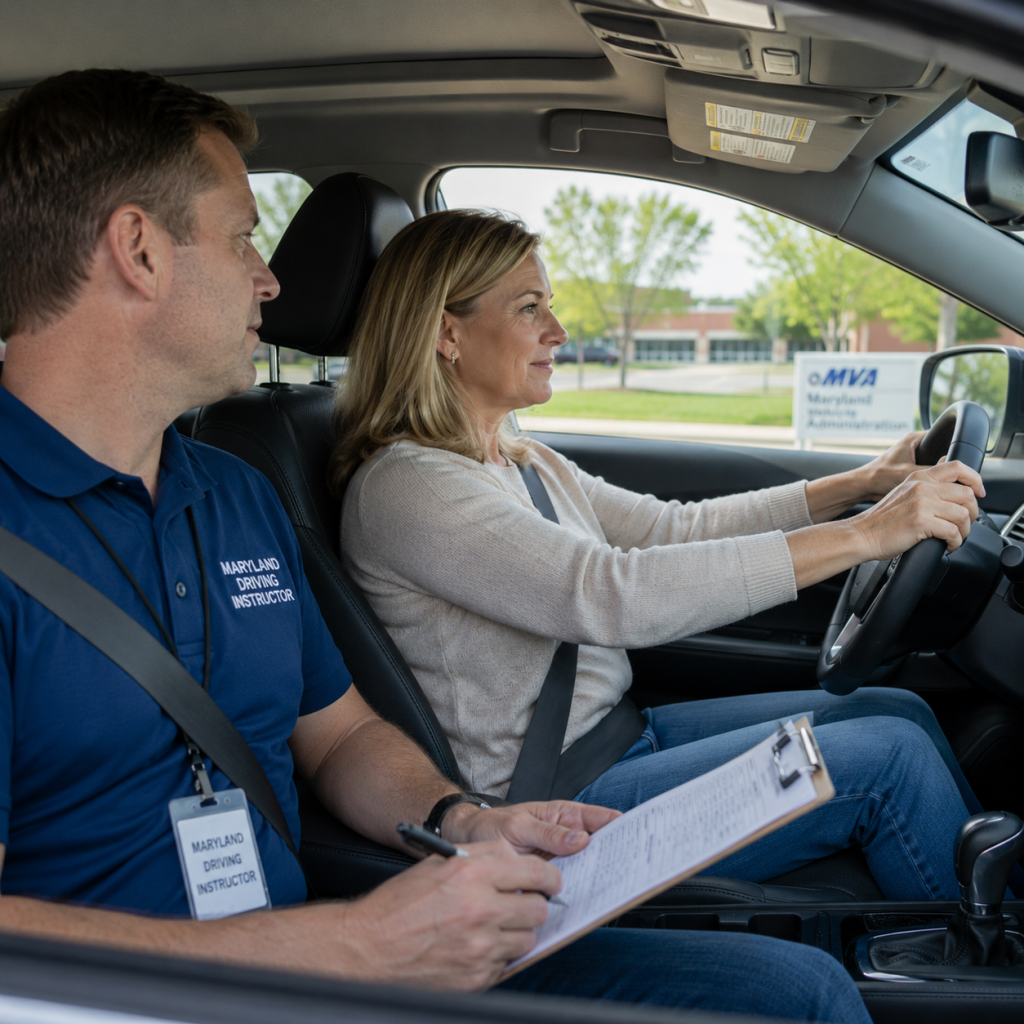
The practical portion consists of at least six hours of behind-the-wheel instruction.
This is where the concepts introduced during classroom education begin to become driving habits.
Under Maryland regulations, behind-the-wheel instruction must be provided by a certified instructor or an apprentice instructor under the required supervision. A student must also have a valid learner’s permit before participating in this portion of the program.
During practical training, the instructor can evaluate how the student handles the vehicle, observes the surrounding environment, responds to traffic situations, and applies safe-driving techniques.
For a beginner, this supervised environment is particularly valuable. Early driving mistakes often happen because a student is trying to process several things at once: vehicle control, mirrors, signs, other cars, pedestrians, lane position, speed, and directions. Structured instruction helps organize those responsibilities into repeatable habits.
The six hours should therefore be viewed as guided professional instruction rather than simply six hours of accumulating road time.
Maryland regulations also require evaluation of student performance according to the learning objectives in the approved curriculum. Observation time while another student is driving does not count toward the student’s minimum six hours behind the wheel.
At Astick Driving School’s 36-hour driver education course, the practical component gives new drivers an opportunity to develop their skills with professional guidance instead of having to figure everything out alone.
This is one of the most common sources of confusion.
You do not need a learner’s permit simply to begin the classroom portion of driver education. However, Maryland requires you to have a valid learner’s permit before participating in the behind-the-wheel portion.
That distinction can help students plan more efficiently.
Instead of assuming that the entire driver education process must wait until after obtaining a permit, a student can explore enrollment options and begin progressing through the appropriate classroom component while working through the permit process.
Maryland currently allows applicants to apply for a learner’s permit beginning at age 15 years and 9 months. Obtaining the permit involves meeting MVA requirements, including the knowledge test.
Students preparing for that stage should study the Maryland Driver’s Manual and use current MVA resources rather than treating the 36-hour course and the learner’s permit test as interchangeable requirements.
Understanding how to get a learner’s permit in Maryland can therefore make the overall licensing journey much easier to organize.
Does the Course Include Everything You Need Before the Maryland Road Test? No
Not necessarily, and this is an important distinction.
The 36-hour course satisfies the certified driver education component, but new drivers can have additional requirements before becoming eligible for a provisional license.
Depending on age and education status, Maryland requires learner’s permit holders to keep the permit for a minimum period and complete supervised driving practice. Drivers age 24 and younger generally need 60 supervised practice hours, including at least 10 nighttime hours. Drivers age 25 or older currently need 14 supervised practice hours, including at least three nighttime hours.
Those supervised practice hours are separate from the six hours of professional behind-the-wheel instruction included in driver education.
In practical terms, this means students should think about becoming licensed as a progression rather than one course:
learner’s permit → certified driver education → supervised driving practice → MVA driving skills test → provisional license.
Some of these stages can overlap depending on the driver’s eligibility and circumstances, but completing the 36-hour course should not be interpreted as eliminating every other licensing requirement.
This distinction is particularly useful for parents and adult students planning how much practice will be necessary outside formal instruction.
What Happens After You Complete the 36-Hour Driver Education Course?
After successful completion, the driving school electronically submits verification of completion to the Maryland MVA.
That means students generally do not have to treat their driver education completion as an isolated paper certificate that they personally use to prove the requirement at every stage.
However, course completion does not automatically mean you are ready to take the road test the following day.
You still need to satisfy the requirements that apply to your age and licensing situation. For a provisional license, these can include holding your learner’s permit for the required period, completing the required supervised driving practice, maintaining the required driving record, and presenting the necessary practice documentation.
When those requirements have been satisfied, the next major milestone is the Maryland MVA road test.
This is why good driver education should prepare you for more than course completion. The ultimate objective is to develop the knowledge, vehicle control, awareness, and decision-making skills needed to drive safely without an instructor sitting beside you.
Are the 6 Behind-the-Wheel Hours the Same as Your Supervised Practice Hours?
No. This deserves special attention because confusing these requirements can create unpleasant surprises later in the licensing process.
The six behind-the-wheel hours are part of the certified Driver Education Program and are conducted through the driving school.
Supervised practice is an additional Rookie Driver requirement that eligible drivers complete with an appropriate supervising driver. The number of required practice hours depends on the driver’s age and other applicable licensing conditions.
Think of the six professional hours as structured instruction and the additional supervised hours as the repeated practice needed to reinforce and expand those skills.
A student might learn an important technique with an instructor during driver education, but confidence and consistency develop by applying good habits repeatedly in different traffic, weather, lighting, and roadway situations.
For that reason, families should plan for both professional instruction and sufficient practice rather than assuming one replaces the other.
How Long Does It Take to Complete Maryland Driver Education?
Although the program contains 36 required instructional hours, “36 hours” should not be interpreted as meaning the entire program is normally completed in one continuous 36-hour period.
The classroom component is divided across scheduled sessions, while behind-the-wheel instruction must be scheduled separately around instructor and student availability.
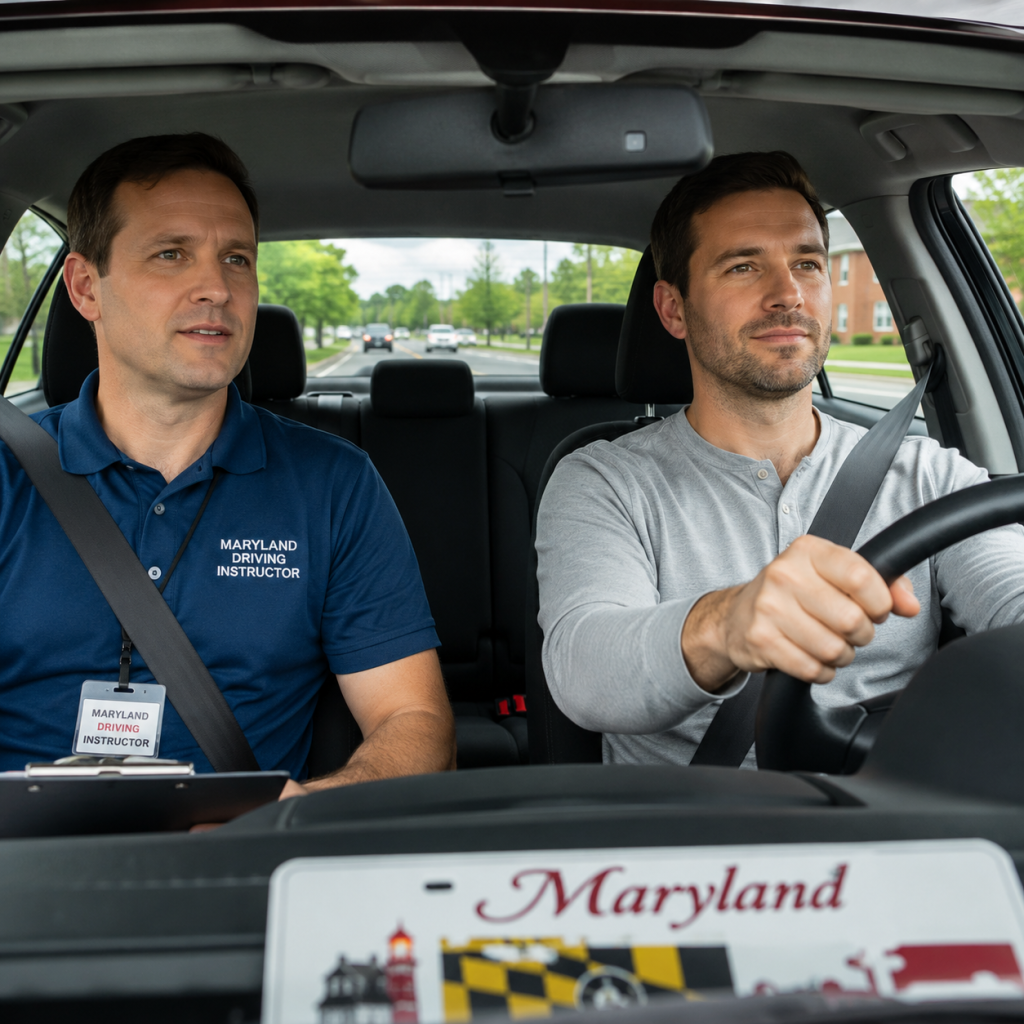
Maryland regulations state that certified schools must organize their schedules so students can complete the required six behind-the-wheel hours within 18 weeks, unless the student requests a longer period.
The actual timeline for an individual student can therefore depend on the classroom schedule, completion of required sessions, possession of a valid learner’s permit for behind-the-wheel training, and driving appointment availability.
When comparing schools, it is worth asking not only when the classroom course starts but also how the school handles practical lesson scheduling.
How Is Online Driver Education Different From Behind-the-Wheel Training?
Online instruction can make the classroom portion more convenient, but it does not turn the entire Maryland Driver Education Program into a self-paced online driving course.
The classroom and in-vehicle phases serve different purposes. An approved online classroom format provides instruction in the required curriculum, while the practical component still requires the student to get behind the wheel and complete the required training with an instructor.
Astick currently offers 30 hours of online driver education combined with six hours of practical driving lessons.
For students balancing school, work, family responsibilities, or other commitments, this format can make the theoretical component easier to incorporate into their schedule while preserving the hands-on training that new drivers need.
How Much Does the 36-Hour Driver Education Course Cost?
Driver education prices vary by Maryland driving school, so students should compare what is actually included rather than choosing based only on the number shown in an advertisement.
At the time this article was prepared, Astick Driving School lists its 36-hour Driver Education Course at $380, including the 30-hour classroom component and six hours of practical driving instruction. Astick also lists flexible payment options.
Because prices, schedules, and enrollment conditions can change, students should verify the current course information when registering.
More importantly, make sure you understand whether the advertised price represents the complete driver education program. Maryland treats classroom and in-vehicle education as components of the Driver Education Program, so knowing exactly what your tuition covers can prevent confusion later.
How to Choose a Maryland Driving School for the 36-Hour Course
Price matters, but it should not be the only factor.
Maryland’s own guidance recommends making sure the school is licensed by the MVA. This matters because approved completion must be properly reported as part of the licensing process.
Students should also consider instructor experience, communication, practical lesson availability, location, classroom schedule, payment and refund policies, and how comfortable they feel asking questions.
The best driving school in Maryland for a new driver is one that does more than move students through required hours. It should help them understand what they are doing, correct unsafe habits early, and progressively develop confidence without sacrificing safety.
For students in Gaithersburg and surrounding Maryland communities, Astick Driving School offers the complete 36-hour program with classroom education and behind-the-wheel instruction designed to help beginners progress through this important stage of the licensing process.
Start Your Maryland Driver Education With Astick Driving School
Getting a driver’s license can feel complicated when learner’s permits, classroom requirements, driving hours, practice logs, and the MVA road test are all discussed at the same time.
The process becomes much clearer when you break it into stages.
The Maryland 36-hour Driver Education Program gives you an essential foundation: 30 hours dedicated to driver education and six hours of professional behind-the-wheel instruction. From there, you can continue building the supervised experience and completing the licensing requirements that apply to you.
Astick Driving School works with new drivers who want clear instruction, hands-on training, and guidance as they progress toward becoming safer and more confident Maryland drivers.
Ready to start your 36-hour Driver Education Course in Maryland? Contact Astick Driving School to check the next available class, confirm current pricing and schedule, and begin your driver education program.