
Driving Anxiety: Tips for Nervous Beginner Drivers
Driving Anxiety: Tips for Nervous Beginner Drivers
Feeling nervous before getting behind the wheel does not mean you cannot become a capable driver. For many beginners, learning to drive means managing several unfamiliar tasks at once: controlling the vehicle, watching traffic, checking mirrors, following signs, anticipating other drivers, and remembering instructions. When all of that happens simultaneously, nervousness can easily become part of the learning experience.
Some students feel uneasy only during their first few lessons. Others are comfortable in a parking lot but become tense around intersections, faster roads, lane changes, heavy traffic, or the thought of taking the driving test. There are also adults who postponed learning to drive for years because driving always felt intimidating.
The solution is not simply being told to “relax.” Confidence develops when unfamiliar situations gradually become familiar and when a learner gains evidence that they can handle one driving skill before moving on to the next.
That is where well-structured driving anxiety lessons can make a difference. Patient instruction, realistic progression, repetition, clear communication, and practice in an appropriate environment can help a nervous beginner replace uncertainty with practical driving experience.
At Astick Driving School, we have worked with teenagers, adults, first-time drivers, international students, and nervous drivers. The goal is not to pressure a student into feeling confident. It is to help the student develop the skills that give confidence a reason to grow.
Why Do Beginner Drivers Feel Anxious Behind the Wheel?
Driving is complex, even though experienced drivers often make it look effortless.
A person who has driven for years may check a mirror, adjust speed, recognize a traffic situation, position the vehicle, and anticipate another driver’s behavior almost automatically. A beginner has not yet developed those patterns.
The new driver may be consciously thinking about every action.
“Am I too close to the curb?”
“Should I brake now?”
“Did I check the mirror?”
“Is that car going to pull out?”
“What if I make a mistake?”
This mental workload can create tension before the student has even traveled very far.
The fear of making mistakes can add another layer. Some learners worry about stalling, turning incorrectly, holding up traffic, missing an instructor’s direction, being honked at, or doing something embarrassing. Others become nervous because they feel they should already be better than they are.
But beginner driving is a learning process. The purpose of instruction is not to demonstrate that you already know how to drive. It is to develop that ability progressively.
For nervous beginners, recognizing this difference can change the entire learning experience.

Why Do Beginner Drivers Feel Anxious Behind the Wheel?
Driving is complex, even though experienced drivers often make it look effortless.
A person who has driven for years may check a mirror, adjust speed, recognize a traffic situation, position the vehicle, and anticipate another driver’s behavior almost automatically. A beginner has not yet developed those patterns.
The new driver may be consciously thinking about every action.
“Am I too close to the curb?”
“Should I brake now?”
“Did I check the mirror?”
“Is that car going to pull out?”
“What if I make a mistake?”
This mental workload can create tension before the student has even traveled very far.
The fear of making mistakes can add another layer. Some learners worry about stalling, turning incorrectly, holding up traffic, missing an instructor’s direction, being honked at, or doing something embarrassing. Others become nervous because they feel they should already be better than they are.
But beginner driving is a learning process. The purpose of instruction is not to demonstrate that you already know how to drive. It is to develop that ability progressively.
For nervous beginners, recognizing this difference can change the entire learning experience.

What Can Trigger Driving Anxiety for a Beginner?
Not every nervous driver is afraid of the same thing.
One student may feel comfortable controlling the vehicle but become anxious around other cars. Another may dislike intersections. Someone else may be worried about making a left turn, changing lanes, parking, merging, driving at night, or eventually taking the Maryland driving test.
For some learners, the anxiety begins before the lesson. They may spend hours thinking about everything that could go wrong. For others, nervousness appears only when the driving environment becomes more demanding.
A previous negative experience can also affect confidence. A learner who was criticized aggressively, had a frightening moment behind the wheel, or felt pushed beyond their current skill level may approach the next lesson expecting another bad experience.
Identifying the specific situation that creates the most tension is useful because “I am afraid of driving” is a very broad problem. “I get nervous when I have to change lanes in traffic” is much more specific.
Specific challenges can be practiced.
That principle is central to effective driving lessons for nervous drivers: instead of trying to solve every fear at once, instruction can focus on manageable driving tasks and progressively increase complexity.
How Driving Anxiety Lessons Can Help Build Confidence
Good instruction for a nervous driver is not simply an ordinary driving lesson with more encouragement.
The structure matters.
A beginner usually benefits from understanding what will happen before the vehicle starts moving. Clear expectations reduce uncertainty. If the student knows that today’s goal is basic vehicle control, smooth braking, turns, or positioning rather than suddenly being asked to handle a difficult traffic situation, more attention can be directed toward learning.
Progression matters too.
There is little benefit in introducing a challenging situation before the learner has the underlying skills necessary to manage it. A student who is still struggling with steering control, observation, or braking may become overloaded if too many additional demands are introduced simultaneously.
Professional instruction can break driving into smaller skills, practice them repeatedly, and combine them as the student’s ability develops.
This creates an important shift.
Instead of thinking, “I hope nothing goes wrong,” the student can begin thinking, “I know what to do here.”
That is the kind of confidence beginner drivers need.
Start With Manageable Driving Situations
A nervous beginner does not need to prove anything during the first lesson.
Starting in a lower-pressure environment allows the learner to become familiar with the vehicle and basic routines without processing the most complicated traffic situations at the same time.
As control improves, the driving environment can become progressively more demanding.
The key word is progressively.
Learning to drive should not become a permanent attempt to avoid every uncomfortable situation, because independent driving eventually requires dealing with real traffic. At the same time, jumping immediately into situations that exceed the student’s current abilities can make learning unnecessarily stressful.
The objective is to find the next manageable challenge.
For example, a student who is comfortable on quiet roads but nervous at intersections does not necessarily need to spend every future lesson avoiding intersections. The instructor can instead introduce simpler intersections, reinforce observation and decision-making, and then progress toward more complex situations as the learner becomes consistent.
Confidence grows from successful experience, not from avoiding every challenge.
Tell Your Driving Instructor What Makes You Nervous
One of the most useful things a nervous student can do happens before a difficult maneuver: communicate.
An instructor cannot adapt effectively to a concern they do not know exists.
If lane changes make you nervous, say so. If you need instructions slightly earlier, explain that. If your previous lesson left you confused about a particular maneuver, bring it up before moving to something more difficult.
This communication should work in both directions.
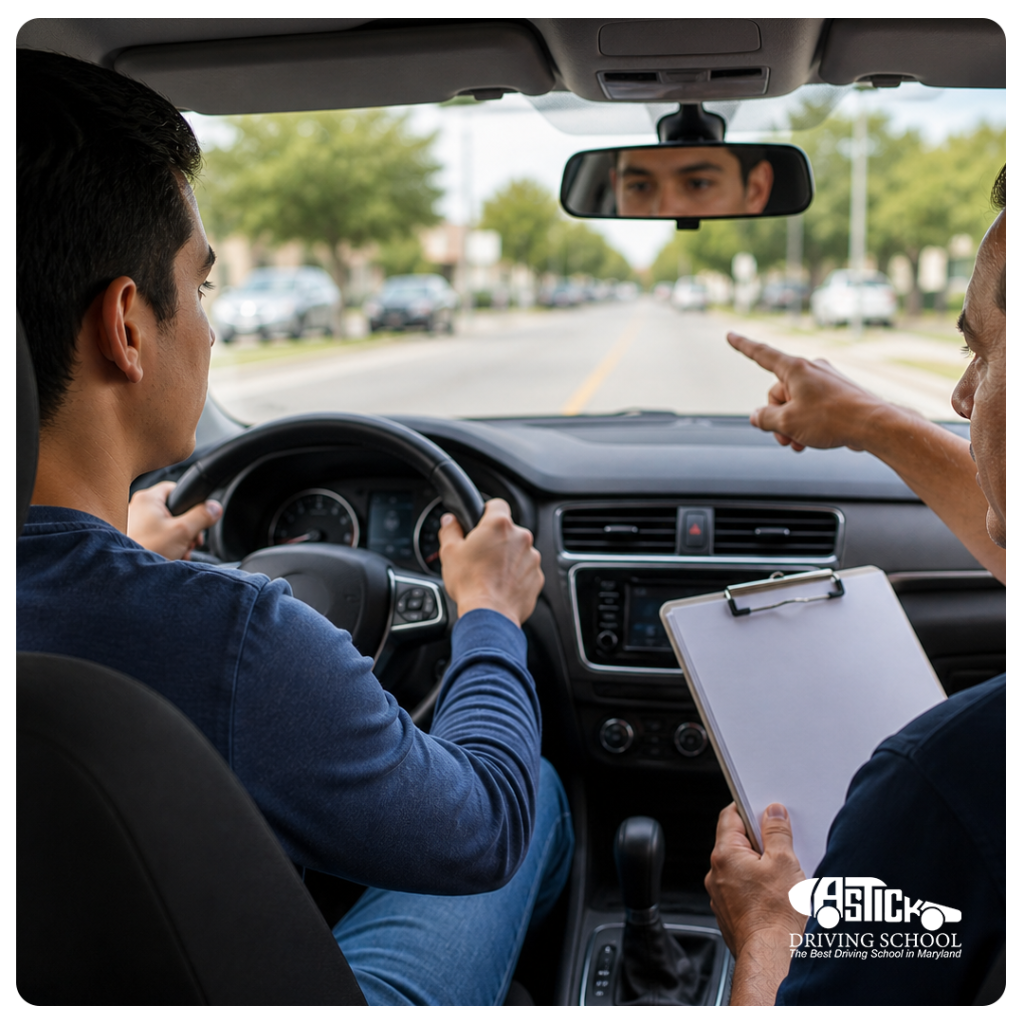
A good driving instructor for nervous drivers should be able to explain what the student is going to practice, identify what needs improvement, and provide feedback that is specific enough to be useful.
“Drive better” is not useful feedback.
“You need to check your mirror earlier before changing lanes” gives the learner something concrete to correct.
Clear instruction reduces guessing, and reducing unnecessary guessing can make the learning environment much easier to manage.
Focus on One Driving Skill at a Time
Nervousness often increases when the learner feels that everything is happening at once.
One way to reduce that overload is to focus on specific skills.
During one part of a lesson, that might mean concentrating on smooth braking and stopping position. Another session might place more emphasis on turns and lane positioning. Later, the learner can work on lane changes, traffic interaction, parking, or other skills.
Of course, real driving requires multiple skills simultaneously. Breaking them down during instruction is not meant to keep them separate forever. It gives the student enough repetition to make individual actions more familiar before combining them in more complex environments.
This is one reason repetition matters.
Repeating a maneuver is not evidence that you are failing to learn it. Repetition is part of how a new action becomes more predictable.
For an anxious beginner, predictability can be particularly valuable.
Do Not Measure Your Progress Against Other Learners
One of the fastest ways to make learning more stressful is to compare your progress constantly with someone else’s.
Your friend may have become comfortable with parking quickly. Your sibling may have passed a test on the first attempt. Another student may seem relaxed in traffic after only a few lessons.
None of those comparisons tells you how quickly you should progress.
People begin driving with different levels of familiarity, coordination, confidence, previous experience, and opportunities to practice. Even two complete beginners can respond very differently to the same lesson.
The more useful comparison is with your own previous driving.
Are your stops smoother than they were three lessons ago? Are you checking mirrors more consistently? Do you understand intersections better? Can you maintain your lane position with less conscious effort? Does a situation that once felt overwhelming now feel manageable?
Those changes are evidence of progress.
Prepare Before Your Driving Lesson
Anxiety can begin long before the lesson itself. A little preparation can reduce avoidable uncertainty.
Know when and where your lesson begins. Wear appropriate footwear. Give yourself enough time so that arriving late does not create additional stress. If there is a specific skill you want to discuss, make a mental note of it before the lesson.
It can also help to think about the previous session.
Instead of replaying every mistake, identify one thing that improved and one thing that still needs work. That gives the next lesson a practical starting point.
Avoid placing unnecessary pressure on yourself with expectations such as, “I have to master parking today,” or “I cannot make any mistakes.”
A more productive objective is: “Today I want to understand this maneuver better than I did before.”
Learning is much easier to measure that way.
Practice Consistently Instead of Waiting Until You Feel Completely Confident
A common trap for nervous learners is waiting to feel confident before practicing.
But confidence often develops because of practice, not before it.
In Maryland, learner’s permit holders can practice on public roads only under the applicable supervision requirements. A qualified supervising driver must accompany the permit holder, and Maryland requires new drivers to document supervised practice as part of the graduated licensing process when applicable.
For nervous beginners, that supervised practice can reinforce what was introduced during professional instruction.
The quality of practice matters, however.
A tense practice session filled with conflicting instructions or pressure may not reinforce the habits your instructor is trying to build. When possible, the supervising driver and learner should approach practice with a clear objective rather than trying to cover every possible skill during one drive.
If you are currently progressing through the licensing process, understanding Maryland supervised driving practice requirements can also help you plan your training instead of treating practice hours as something to complete at the last minute.
What If You Make a Mistake During a Driving Lesson?
You probably will.
Every beginner makes mistakes because learning requires doing things that are not yet automatic.
The important question is what happens after the mistake.
A useful lesson turns the mistake into information. What happened? Why did it happen? What should you notice earlier next time? What action should you take differently?
That process is much more valuable than simply feeling embarrassed about what went wrong.
Imagine a learner approaches a turn too quickly. The useful takeaway is not, “I am bad at driving.” The useful takeaway is that speed should be adjusted earlier before entering the turn.
One interpretation attacks the learner. The other identifies a skill.
That difference matters enormously when building confidence.
Mistakes should be corrected, but they do not need to define the entire lesson.
How to Handle Anxiety About Other Drivers
The best preparation is not trying to eliminate every nervous feeling before test day. It is developing enough familiarity with the required driving skills and testing process that nervousness does not replace your normal driving habits.
Practice should therefore become increasingly independent as the learner progresses.
Instead of relying on constant prompts, the student needs opportunities to observe, decide, and act without waiting for the instructor to provide every answer.
Maryland’s behind-the-wheel test evaluates whether the applicant can safely operate a vehicle, beginning with a closed-course component and then progressing to public-road driving after successfully completing the first portion.
Understanding what to expect on the Maryland MVA road test can reduce some of the uncertainty surrounding test day and help students focus their preparation on actual driving skills.
When Should You Consider Additional Driving Lessons?
Completing a minimum requirement and feeling ready to drive independently are not always the same thing.
Some students need additional practice with one or two skills. Others want extra preparation before their road test. A nervous learner may simply benefit from additional time with an instructor before handling more challenging driving situations independently.
Additional lessons can be particularly useful when you notice that the same problem continues to appear despite practice.
Perhaps lane changes remain difficult. Maybe parking is inconsistent. Perhaps you understand intersections in theory but hesitate when making decisions in real traffic.
An instructor can identify whether the issue involves vehicle control, observation, timing, decision-making, or simply insufficient repetition.
That makes additional training purposeful rather than just adding more hours.
What Should Nervous Drivers Look for in a Driving School?
Professionalism matters just as much as patience.
A nervous learner still needs accurate instruction, correction of unsafe habits, and gradual exposure to the skills required for independent driving. A supportive environment should not mean avoiding necessary skills indefinitely.
The ideal combination is patient but purposeful instruction.
In Maryland, beginners should also understand where private driving lessons fit into the broader licensing process. Maryland’s Rookie Driver system begins with a learner’s permit, followed by driver education and required practice before eligible drivers progress toward the provisional license.
Students who are still at the beginning of that process can benefit from understanding the Maryland 36-hour Driver Education Course and how formal instruction fits into the state’s licensing requirements.
Driving Anxiety Lessons in Maryland With Astick Driving School
Learning to drive should build independence, but the beginning of that journey can feel intimidating.
Astick Driving School has more than 20 years of experience in driver education and road-test preparation and has worked with more than 25,000 students, including teenagers, adults, first-time drivers, international students, and nervous drivers.
Our approach emphasizes professional instruction in a supportive, patient learning environment.
For a nervous beginner, that means the goal is not to pretend the anxiety does not exist. The goal is to keep developing the practical skills that make driving more familiar: vehicle control, observation, positioning, decision-making, traffic awareness, and preparation for independent driving.
If you are looking for driving lessons in Maryland because nervousness has made it difficult to begin, return to driving, or prepare for your road test, professional instruction can give you a structured place to practice.
You do not need to become a fearless driver.
You need to become a prepared, attentive, and safe one.
Frequently Asked Questions About Driving Anxiety Lessons
Are driving lessons good for nervous drivers?
Professional driving lessons can help nervous beginners build familiarity and practical skills in a structured environment. A patient instructor can break difficult driving situations into smaller skills, provide specific feedback, and gradually introduce more complex conditions as the student’s ability develops.
What are driving anxiety lessons?
Driving anxiety lessons are driving lessons adapted to students who feel particularly nervous or uncomfortable behind the wheel. They can emphasize clear communication, manageable progression, repetition, and confidence-building while still teaching the driving skills necessary for safe independent driving.
Should I tell my driving instructor that I have driving anxiety?
Yes. Letting your instructor know what situations make you nervous can help them understand your concerns and adapt instruction appropriately. Being specific is especially useful—for example, explaining that lane changes, intersections, parking, or heavy traffic make you uncomfortable.
How can a beginner stop being nervous while driving?
There is no single technique that works for every learner. Practical approaches include starting with manageable situations, practicing consistently, focusing on one skill at a time, communicating with your instructor, and gradually increasing the complexity of the driving environment as your skills improve.
Can I take extra driving lessons if I already completed driver’s education?
Yes. Additional behind-the-wheel practice can be useful for drivers who want more experience, need help with specific skills, are preparing for a road test, or do not yet feel ready to drive independently.
What if I am afraid of taking the Maryland road test?
Test-day nervousness can be reduced by becoming familiar with the skills and procedures you will encounter and practicing until your driving decisions require fewer prompts. Maryland’s driving skills test includes a closed-course component followed by public-road driving if you successfully complete the first part.
Can Astick Driving School work with nervous beginner drivers?
Yes. Astick Driving School has experience working with teenagers, adults, first-time drivers, international students, and nervous drivers. The school emphasizes professional instruction in a supportive, patient environment.
Can driving lessons treat an anxiety disorder?
No. Driving instructors teach driving skills and can provide a supportive environment for nervous learners, but driving lessons are not mental health treatment. If anxiety is severe, produces panic symptoms, affects other areas of life, or makes driving unsafe, consider seeking guidance from a qualified healthcare or mental health professional.